
Tour introduces grad students to careers in Idaho spud industry
By John O’Connell
University of Idaho
MOSCOW, Idaho – Ten University of Idaho graduate students who participated in a recent tour of the state’s potato industry witnessed the full supply chain, from early seed production through shipping fresh and frozen spud products to buyers.
In 2014, potato farmers Doug Gross, of Wilder, and Jeff Harper, of Mountain Home, established the Idaho Potato Graduate Industry Program Endowment to recognize the important role that the potato industry plays in Idaho agriculture and the ways in which the College of Agricultural and Life Sciences (CALS) assists the potato industry in teaching, research and Extension.
Every two years, the tour exposes U of I graduate students to all aspects of the Idaho potato industry, including potato production, storage, biotechnology, fresh pack systems, processing, equipment, irrigation, food science, seed certification and production, marketing and agri-businesses involved in crop research. The goal is to raise their awareness of job opportunities in potato production.
The 2026 tour — hosted May 18-21 for six doctoral students and four graduate students — was led by Nora Olsen, potato specialist, and Gustavo Teixeira, potato postharvest physiologist who holds the Wayne and Peggy Thiessen Potato Research Professorship Endowment.
The tour started at the Idaho Potato Commission (IPC) offices in Eagle, where CEO Jamey Higham provided industry updates, before moving on to Gross Farms in Wilder.
“The whole idea was to expose young people to the industry because we must have a replenishment of workers,” said Gross. “Most college kids or graduate students don’t get the opportunity to get out into the businesses and see what’s really going on, what our concerns are as farmers and what needs to be worked on.”
At U of I’s Parma Research and Extension Center, Armando Falcon-Brindis, an Extension specialist in entomology, provided a hands-on activity identifying important aphids in potatoes. Next, at Simplot Plant Sciences, they discussed how the company is using biotechnology for disease resistance and quality.
The group also visited Harper’s Flying H Farms and had the chance to dig in fields and see newly forming tubers before witnessing how fries are made at Lamb Weston in Twin Falls. The next stop was learning about proper potato storage management with Agri-Stor in Hansen.
At U of I’s Aberdeen Research and Extension Center, Operations Manager Chad Jackson explained the facility’s many contributions to Idaho agriculture, including its role in developing russet potatoes for the processing markets.
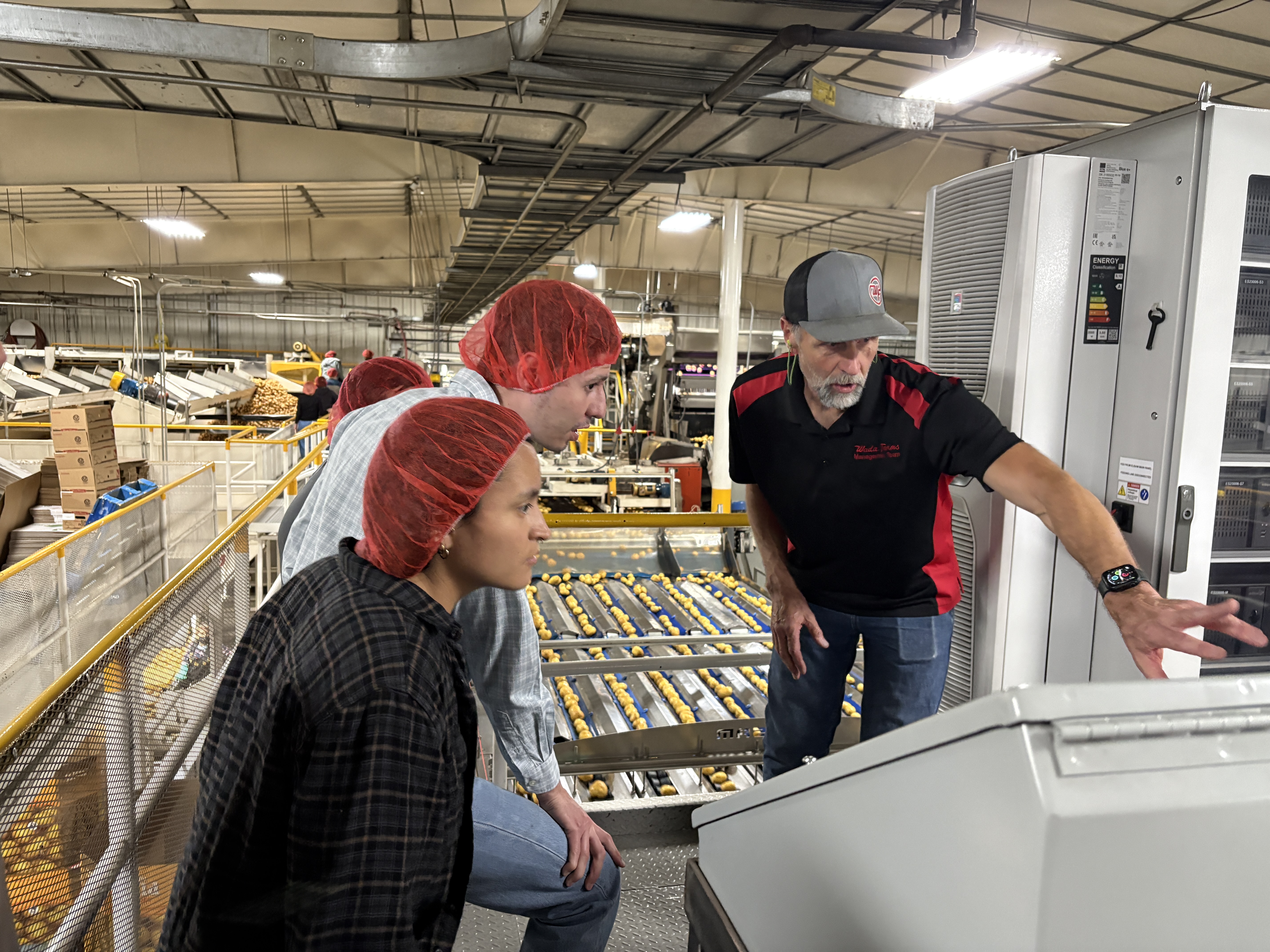
The students then stopped at Wada Farms in Pingree to tour a large fresh potato packing plant that ships product throughout the world. Kip Yeates, vice president of fresh operations with Wada Farms, explained U of I researchers, including Olsen, provide their business with invaluable services, including research into the physiology of fresh potatoes in transit.
Managers of Blackfoot-based Spudnik Equipment, Evan Steel and Andrew Blight, showed the students how modern equipment used in potato production, storage and harvesting is manufactured.
The last day of the tour was dedicated to seed potato production. Students visited Atchley’s Flying A Ranch in Ashton, where tissue cultures produced at U of I’s Seed Potato Germplasm Laboratory in Moscow are raised in a sterile greenhouse to produce the earliest generation of disease-free potato seed by Emma Atchley and Laura Pickard.
At the final stop, Idaho Crop Improvement Association in Idaho Falls, Southeast Area Manager Alan Westra highlighted Idaho’s seed certification authority, which has ensured a high-quality seed supply for Idaho for more than 78 years.
Students who participated in the tour have already made significant contributions toward Idaho agriculture. Adison Reyes, a doctoral student from Ecuador working under Alexander Karasev, a distinguished professor of plant virology, has been using next-generation sequencing technology to discover new viruses and viruses associated with various crops. He’s been working primarily in legumes and grapevines. The tour allowed Reyes to experience new facets of the agricultural industry.
“It’s an amazing opportunity for learning the whole process, from the marketing part through food processing and the whole production process; it’s just amazing and highly technical,” Reyes said.
Alexandra Sims, a master’s student from Connecticut studying plant pathology under Kasia Duellman, an Extension plant pathology specialist based in Idaho Falls, has studied a fungal disease called Fusarium dry rot that affects potatoes from the field through storage,
“This was an opportunity to see a side of the industry that I hadn’t seen yet — a bit of the agricultural equipment, a bit of the farming and planting,” Sims said.
Sims was especially interested in seeing advanced potato storages during the tour.
“I know a lot about the things that can go wrong in storage facilities, but I got to learn a lot about how to make everything go right,” Sims said.
“The tour is an in-person, face-to-face experience,” Teixeira said. “They can talk to growers, they can talk to processors, and they learn a lot during the process. It’s also a good venue for the students to get in contact with the industry so they may be hired in the future.”
Still can't find what you are looking for? Find by topic:
- County Presidents & Board Information
- County Resource Page
- Delegate Form
- Discount Programs
- Discussion Meet
- Discussion Meet - High School
- Education Programs
- Events
- Excellence Award (YF&R)
- Expense Voucher
- Flickr- Photos
- Gem State Producer
- High School Discussion Meet
- High School Speech Contest
- Hope in Idaho Ag
- House of Delegates Credentials Form
- IFBF Board of Directors
- IFBF Staff
- Insurance
- Issue Advisory
- Legislative Action Program
- Legislative Issues
- Library
- MAC Trailer
- Magazines
- Map My Benefits
- Member Benefits
- Member Discount
- Membership Application
- Mental Health Resources
- Mission Statement
- Moving Agriculture to the Classroom
- Newsletter Sign up
- News Releases
- News Room
- Open Range Law
- Photo Contest
Thank You to Our Partners


