
Summit tackles farmland loss issue
By Sean Ellis
Idaho Farm Bureau Federation
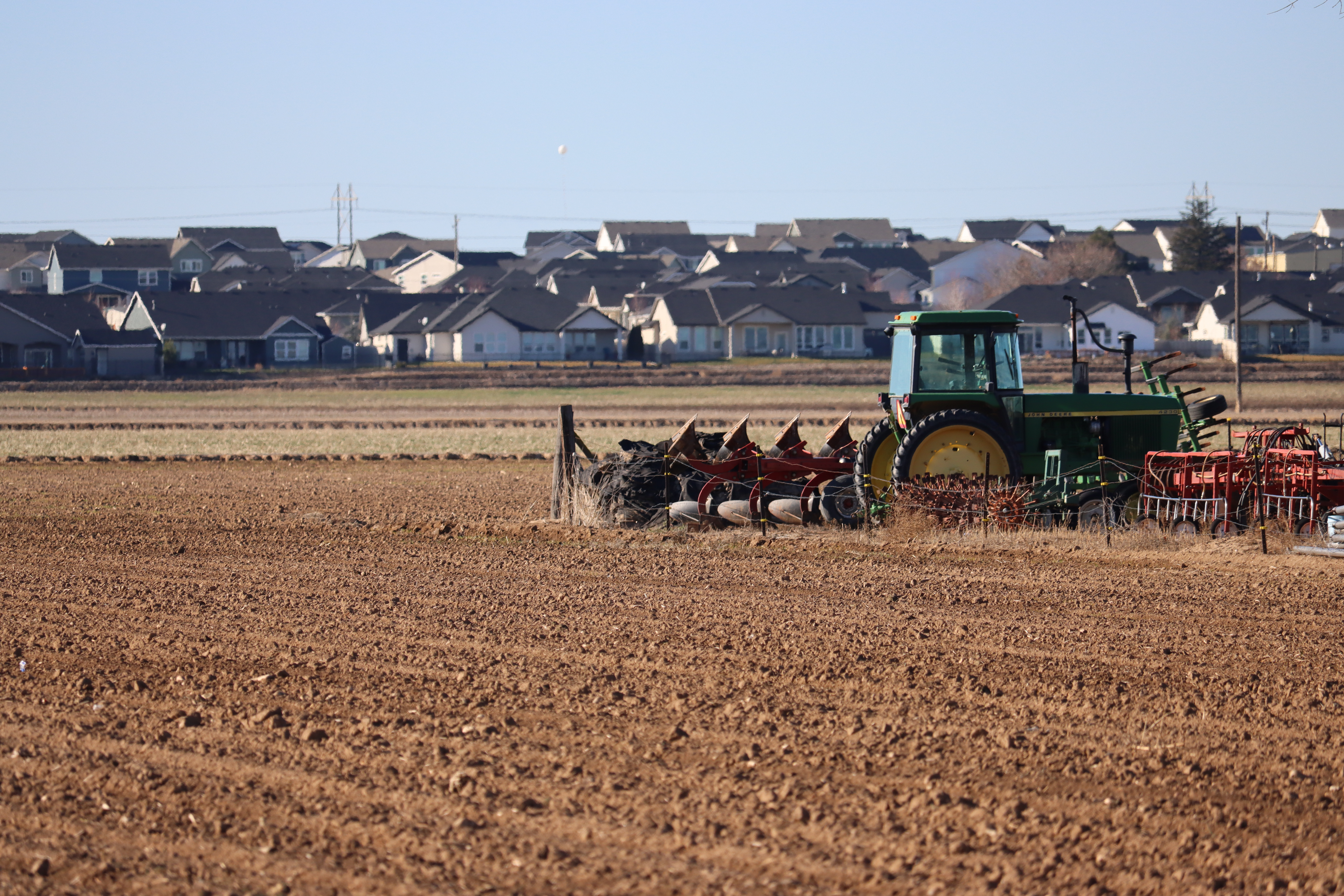
BOISE – Idaho’s rapid population growth is impacting farmland and not in a good way.
The development that has come along with that growth has increasingly resulted in the loss of more farmland.
From 2017 to 2022, 144,000 acres of agricultural land in Idaho disappeared, according to USDA’s 2022 Census of Agriculture.
During that same time, the state lost 2,119 farms and ranches.
Though many of those were small operations that account for a small percentage of the state’s overall agricultural production, those numbers demonstrate the increasing pressure that development is placing on farmland in Idaho.
The situation has gotten so serious that Gov. Brad Little, himself a rancher and farmer, held a summit to sound an alarm on the issue and lay the groundwork to try to find ways to preserve farmland in Idaho.
About 240 people attended the Governor’s Summit on Agricultural Viability in Idaho Dec. 18. Another 85 watched it online.
The all-day event was held in the Capitol building and included farm and ranch landowners and leaders of Idaho farm groups and agribusinesses.
It included members of academia and conservation groups that are interested in preserving farmland, as well as government agencies that have a stake in agriculture.
Idaho Farm Bureau Federation, American Farmland Trust and the Idaho State Department of Agriculture organized the summit, which was attended by about 10 legislators.
“This topic has garnered a lot of attention over the past several years,” Braden Jensen, IFBF’s director of governmental affairs, told participants.
Jensen and others stressed how important the agriculture industry is to Idaho and why it’s so important to protect it.
There are still 22,000-plus farms and ranches and more than 11 million acres of farmland in Idaho, according to the 2022 ag census.
A recent University of Idaho study found that one in nine jobs in Idaho are directly or indirectly attributed to agriculture, as well as 17 percent of total sales and 13 percent of the state’s total gross state product.
“Agriculture is the backbone of our state and it’s facing a lot of pressure,” Jensen said.
“Ag and food processing in the state of Idaho contribute $26 billion to our economy,” ISDA Director Chanel Tewalt told participants. “There is no stronger or more important industry in the state of Idaho.”
“As massive and productive and incredible as agriculture is here in Idaho, it is facing massive headwinds,” she added.
The governor, Jensen and other presenters made it clear the ideas discussed during the summit would not necessarily represent their organization’s position on farmland preservation.
Jensen said later that the main reason for the summit was to raise awareness of the issue outside of just agriculture and to get conversations started.
“We hope this summit helps spur further discussions,” he said. “What was accomplished during the summit was increasing the awareness of this issue and getting the conversations started, outside of just Farm Bureau and ag circles.”
One thing that summit speakers did agree on was that the issue of farmland preservation is a complicated one and there are no easy solutions.
“This is something I’ve spent an inordinate amount of time on and there is no one (simple) solution,” said Little.
Tewalt said farmland preservation is an incredibly difficult topic to discuss and “there are no perfect, easy answers to this.”
A plethora of possible ways to help stem the loss of farmland were discussed during the summit. One of those was the need to incentivize farmers to not sell their land for development.
“Who can blame someone for wanting to maximize the profits they can make from their land,” said Jennifer Reibe, a crop consultant and member of the Payette County Board of Commissioners.
She said the topic of farmland preservation should put a big focus on “what we can do to incentivize landowners to stay on their land and continue farming.”
The need to find an Idaho solution without too much government involvement was another point.
“It’s really, really important that we don’t get government” overly involved, said IFBF President Matt Dorsey.
Dorsey, who farms in Canyon County, said the main focus of the discussion should be not solely on farm ground but also on the agricultural producers themselves who have built the industry into what it is today in Idaho.
“We need to make sure we don’t overlook producers,” he said. “We need to be focused on protecting our producers.”
The use of zoning as a tool to help preserve farm ground was another main topic of discussion.
Idaho’s Local Land Use Planning Act (LLUPA) “is the largest tool in the toolbox we have for protecting agriculture,” said Keri Smith, executive director of Growing Together, which focuses on preserving ag land in Canyon County.
George Crookham, CEO of Crookham Company, a family-owned seed business located in Caldwell, said LLUPA, which was passed into law five decades ago, spells out what counties and municipalities have to take into consideration when planning and approving development.
One of those things, he said, is how development will impact a neighborhood and the broader community.
He believes LLUPA is an overlooked tool that can and should be used to direct orderly development and help preserve farmland.
“It’s already in state statute,” Crookham said about LLUPA. “It’s been there for 50 years.”
Preserving the private property rights of farmers and ranchers was another topic of discussion.
“We have to respect property rights and make sure we’re not infringing on them,” Jensen said.
The trick, he added, is respecting property rights while also preserving farmland.
Something needs to be done, summit presenters said, because the rapid growth and development Idaho has experienced in recent years isn’t stopping.
Jaap Vos, a University of Idaho researcher, presented data that shows one in four people in Idaho now were not here before 2010.
“We are no longer the middle of nowhere,” Vos said. “If we don’t start protecting the things we care about – the things that make Idaho what it is – they will be gone before we know it.”
Jodi Brandt, a Boise State University researcher, presented results from a BSU study that estimates 64 percent of farmland in the Treasure Valley will be lost by 2100.
Growth and development pressure in Idaho have accelerated since that study was conducted and it is happening beyond the Treasure Valley, she said.
“Good land doesn’t replace itself,” said David Anderson, the Idaho senior program manager for American Farmland Trust. “Once converted, it’s gone.”
He said fragmentation of farmland – for example, a subdivision plopped in the middle of ag land – is a serious concern in Idaho right now.
Once farmland is fragmented, it is much more likely to be developed, he said.
He pointed to separate studies by researchers from University of Idaho and BYU-Idaho that both show Idaho counties receive more tax benefits from farmland than they do from residential properties.
In essence, he said, the studies show that farmland is subsidizing residential development.
“Unfettered fragmentation of our working lands is cancer to our agricultural economies,” Anderson said. “If we do not get this (under control) … then our economies are really going to start to suffer from the loss of our land base.”
Summit participants were urged to be involved in the discussions about farmland preservation and were reminded that if they’re not at the table, they could be on the menu.
“I sit at the table so I’m not on the menu,” said Mary Huff, Owyhee County’s planning director. “Being involved cannot be overstated for the producers in this room.”
Weiser farmer Tristan Winegar said the summit was a good start and he believes it should happen again, on an even bigger scale.
“We need to touch more people, but it was definitely a good start; it was a success,” said Winegar, president of Washington County Farm Bureau. “The fact that the governor was there and it was held in the Capitol building was a big deal.”
Crookham said he’s been dealing with the topic of farmland preservation for two decades. He said he enjoyed hearing from people during breaks and lunch that they were unaware of some of the issues and solutions.
“It's good that people understand how important ag land is to our economy and how residential development doesn’t pay for itself,” he said.
“It’s great to share but now we need a path forward,” he added.
Winegar, 37, said the rapid loss of farmland has been going on his entire life.
“People need to wake up and realize we are digging ourselves into a hole,” he said. “This is serious and we have to do something … different. Things can’t go on like this.”
Still can't find what you are looking for? Find by topic:
- County Presidents & Board Information
- County Resource Page
- Delegate Form
- Discount Programs
- Discussion Meet
- Discussion Meet - High School
- Education Programs
- Events
- Excellence Award (YF&R)
- Expense Voucher
- Flickr- Photos
- Gem State Producer
- High School Discussion Meet
- High School Speech Contest
- Hope in Idaho Ag
- House of Delegates Credentials Form
- IFBF Board of Directors
- IFBF Staff
- Insurance
- Issue Advisory
- Legislative Action Program
- Legislative Issues
- Library
- MAC Trailer
- Magazines
- Map My Benefits
- Member Benefits
- Member Discount
- Membership Application
- Mental Health Resources
- Mission Statement
- Moving Agriculture to the Classroom
- Newsletter Sign up
- News Releases
- News Room
- Open Range Law
- Photo Contest
Thank You to Our Partners


