
Rancher-influencer encourages farmers to share their stories with the public
By Sean Ellis
Idaho Farm Bureau Federation
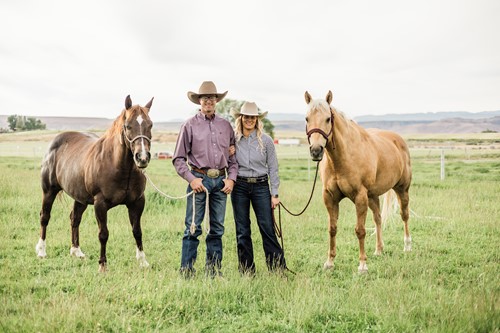 KING HILL – People will get their information about farming and ranching from somewhere or somebody, so it might as well come from real farmers and ranchers.
That’s one of the messages that rancher and online influencer Jessie Jarvis shared with Idaho Farm Bureau Federation members during the group’s annual meeting last December.
“Who is the PR firm for agriculture? It is me and you,” she told IFBF members, who are farmers and ranchers themselves.
She expounded upon that message during a recent interview at the family ranch.
Jarvis is a third-generation rancher who lives and ranches in the King Hill area east of Mountain Home.
The family ranch raises black angus and red angus cattle and also grows alfalfa hay and silage corn. It includes a small feedlot.
“Our ranch is the heart of who I am, and the reason behind why I am so very passionate about agriculture,” she said.
One of the things she is most passionate about is connecting with consumers who want to know more about farming and the people who produce their food.
She encouraged other farmers and ranchers to join her in telling their story to a public hungry for real information about agriculture.
Jarvis grew up on the family ranching operation, then headed to the College of Idaho to pursue a business degree.
She got the opportunity to develop her print and digital communication skills while working as the communications director for the Idaho Cattle Association for two years.
She returned to the ranch in 2013 and now is married with two kids. She has juggled her ranch work with writing freelance articles for ag and western publications.
She has also made it a major focus to connect with consumers. She doesn’t like the word “influencer,” but in reality, she has become one – she has more than 50,000 online followers – interacting with consumers and sharing her own story online.
Jarvis said she was pleasantly surprised by a nationwide Gallup poll in 2024 that showed the American public trusts the farming and agriculture sector more than any other industry in the country.
However, she added, the ag industry can’t assume that positive feeling will always be there and it’s up to farmers and ranchers themselves to do their part to ensure people continue to trust their industry.
“We can’t stay stagnant in not continuing to share what we’re doing and have those one-on-one conversations with people,” she said.
She credits her honesty about the joys and frustrations of ranch life with garnering 56,000 followers online. When wildfires damaged their range, the family debated selling their cattle or using virtual fencing, choosing the latter.
Jarvis encourages agricultural producers to really ask the questions of why people feel the way they do, as opposed to “thinking we know what consumers want to know about ag.”
“That’s why creating a true conversation is so vital,” she said.
It’s easy to find inaccurate or wrong information about farming online, Jarvis said.
“That’s why I think being a trusted voice in your industry is so important,” she said. “Because you are then that person that people can go to for information instead of going to Google.”
That same Gallup poll that showed the public’s trust in farming is high also showed that 54 percent of Americans ages 11-24 have never seen a cow in real life.
“That is absolutely wild,” Jarvis said. “I think that goes to show how important it is for us to continue to showcase and highlight our lives to (the public).”
The good thing about sharing the true story of agriculture is that farmers and ranchers have nothing to hide, she said.
“Why do we rank so high in that poll? Because we have nothing to hide,” she said. “There are no secrets we can’t share. Nobody’s stopping us. Nobody’s limiting us.”
Jarvis said one of the reasons it’s so important for agriculture to be on the offensive when it comes to sharing its story is because, otherwise, it will always be on the defensive.
“When we allow other people to tell our story, then we have to go in and play defense,” she said. “That’s why I think we need to continue to be focused on sharing our story. That is us playing offense; we get to be in the driver’s seat telling our story.”
In December, while speaking to IFBF members as one of the conference’s keynote speakers, Jarvis admitted she was wildly uncomfortable but doing it anyway. She encouraged other farmers to think the same way.
“Maybe we don’t necessarily want to engage, but if we don’t do it, who else is going to do it?” she asked.
“You don’t have to get on a big stage in order to share your story,” she added recently. “You can do it in a one-on-one setting or with your church group or with your PTA or your fellow T-ball moms. Every voice in our industry is so important and needs to be shared and to be heard.”
“So, it does take every single one of us to move the needle and make a difference,” she said. “We need everybody.”
Jarvis also reminded farmers and ranchers that their operation is unique and people outside of the agriculture world really want to know about it.
“It is as unique as your fingerprint,” she said. “Nobody else does it the way that you do it and that is the case for every single farm and every single ranch that exists in America today. So, you have a unique story to tell.”
Samantha Parrott, executive director of the Snake River Sugarbeet Growers Association, agrees with Jarvis’ take on how vital it is to make sure the public hears the real story about agriculture from real farmers and ranchers.
Farmers make up less than 2 percent of the population now and most people today grow up not truly understanding where their food comes from, she said.
“Our industry is complex and the challenges we face, from environmental regulations to economic pressures, aren’t always visible to the public,” Parrott said. “That’s why educating people about agriculture is so important.”
“Agriculture isn’t just a way of life; it’s the backbone of Idaho’s economy,” Parrott added. “We need to do a better job telling our story so that future generations value and support the work that farmers do every day.”
Andi Woolf-Weibye, executive director of the Idaho Bean Commission, said the IBC board has recently been talking specifically about how important it is to tell agriculture’s story.
“We … all need to get together and start telling the story, somehow, and educate more people,” she said. “If we don’t tell our story, somebody else will and they might not have the agriculture industry’s best interests in mind.”
(Freelance writer Dianna Troyer contributed to this article.)
Photo Credit: Nicole Poyo Brennan, Bruneau, ID
Still can't find what you are looking for? Find by topic:
- County Presidents & Board Information
- County Resource Page
- Delegate Form
- Discount Programs
- Discussion Meet
- Discussion Meet - High School
- Education Programs
- Events
- Excellence Award (YF&R)
- Expense Voucher
- Flickr- Photos
- Gem State Producer
- High School Discussion Meet
- High School Speech Contest
- Hope in Idaho Ag
- House of Delegates Credentials Form
- IFBF Board of Directors
- IFBF Staff
- Insurance
- Issue Advisory
- Legislative Action Program
- Legislative Issues
- Library
- MAC Trailer
- Magazines
- Map My Benefits
- Member Benefits
- Member Discount
- Membership Application
- Mental Health Resources
- Mission Statement
- Moving Agriculture to the Classroom
- Newsletter Sign up
- News Releases
- News Room
- Open Range Law
- Photo Contest
Thank You to Our Partners


About the author
Sean Ellis