
Potato growers face some hard challenges
Idaho Farm Bureau Federation
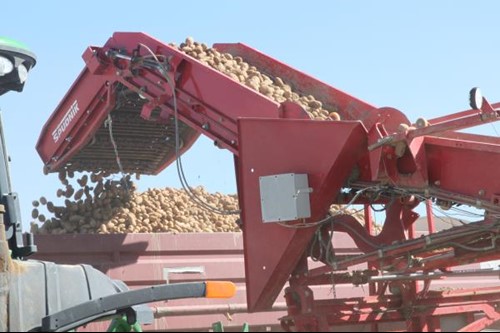 POCATELLO – It’s been a tough couple of years for U.S. and Idaho potato growers. The prices that spud farmers have been receiving for their product are well below what it costs to produce them, creating a difficult financial situation.
With China, India and other nations quickly emerging as competitors in the spud world, other challenges loom as well.
To be sure, Idaho is still the main player in the United States when it comes to potato production. This state produces about a third of the nation’s total potato supply and the potato world domestically still revolves around Idaho.
A presenter made that clear during the Idaho Potato Commission’s annual Big Idaho Potato Harvest Meeting in November.
“Keep being Idaho. Keep doing what you’re doing. Keep growing a lot of Idaho potatoes,” said Tim Grass, director of produce at Associate Wholesale Grocers, the largest retailer-owned cooperative in the United States, with 3,500 grocery stores. “Idaho potatoes are very, very important to our retailers … and their consumers. You guys are the top of the heap.”
But the Idaho and U.S. potato industry in general is facing some stiff challenges right now. The main one is financial – low farm-level prices – and it’s caused by the usual suspect: more supply than demand.
As an example, the North American Potato Market News’ grower return index shows that open-market prices for Russet potatoes are well below $2 per hundred pounds (cwt).
It cost farmers about $8-9 per cwt to grow those spuds and if a farmer stored them through February, the actual cost would be about $12-14 per cwt.
“It’s really bad,” said NAPMN owner Ben Eborn. “Open-market prices are way, way below break-even right now.”
Farm-level potato prices “are about down to where they can’t get any lower,” said Oakley potato farmer Randy Hardy.
“The last three years have been exceptionally difficult on grower returns,” Idaho Potato Commission CEO Jamey Higham said during the potato harvest meeting.
Another, growing challenge is the emergence of China and other nations as major competitors in the global potato market.
On a bright note, global demand for potatoes keeps growing, Potatoes USA CEO Blair Richardson said during the harvest meeting.
“The bottom line is, people really like potatoes,” he said. “World fry demand is strong.”
The not-so-good news is that other countries are getting in on the processed potato game, some in a big way. Such as China.
China will soon become the world’s largest potato grower and will pass total production of the entire European continent in the next year or two, Richardson said.
India is also coming up quickly and had 32 percent production growth over the past year. Southeast Asian countries are also producing more spuds. And Africa. And South America.
“A lot of countries are starting to get into this game,” Richarson said.
“We’re looking at a different global market for potatoes than what we’ve looked at for the past 30-plus years,” he said. “We have competitors that we never even thought about competing against that are now competing with a good, quality product.”
What’s the solution? For one, Richardson noted, the U.S. is a net importer of potatoes.
“Maybe we need to focus on becoming a net exporter of potatoes again,” he said. “Maybe we need to refocus even more of our time, energy and resources on our U.S. foodservice operators and consumers. It’s the one area that we can reach the most with the least amount of money.”
“So, I think that we really have to double down in the United States and rebuild our base here and quit losing opportunities to international companies that are figuring this our faster than we are,” Richardson said.
“We’re aware of what we need to do and we’re going to be relooking at how we’re allocating resources toward these things over the next couple of years,” he added.
Twenty percent of the potatoes produced in the United Stated are exported in some form. Opening new export markets could help ease the financial strain being felt in potato country, National Potato Council CEO Kam Quarles told the potato harvest meeting participants.
Opening Japan to fresh potato imports from the U.S. is the domestic industry’s top priority, he said.
Japan is a major destination for processed potatoes from the United States, but it does not allow fresh U.S potato imports. The National Potato Council estimates that if full market access for fresh U.S. potatoes to Japan is realized, it would result in an additional $150 million per year in exports.
Quarles said Japan has delayed this market access request from the U.S. for 30 years.
“Their strategy is very clear: They want to negotiate with us, but they don’t want the negotiations to ever conclude,” he said. “That protects (their) market. If you never get to the finish line, their market remains closed to us.”
“We are going to stay on this until we get the right response,” Quarles said.
“Japan is our biggest opportunity globally right now,” Richardson said. “We’ve got to get Japan open for fresh potatoes.”
Keeping the Mexico market open to fresh U.S. potatoes is also a major priority, Higham said.
The U.S. fought for decades to open all of Mexico to fresh U.S. potato imports. Every time the U.S. industry appeared to be close to achieving that goal, Mexico’s potato industry successfully put up a roadblock.
But in May 2022, U.S. potatoes were allowed to be exported into all of Mexico, following a unanimous decision by the Mexican Supreme Court in favor of U.S. potato growers.
Keeping that market open and expanding it while preventing any future roadblock attempts is a high priority, Higham said.
“I know we’ve just scratched the surface of what we can sell down there,” he said. “As we move forward, there will be more potential for (fresh) potatoes going into Mexico.”
“Everything we export, that is less pressure on the domestic market,” Higham added. “A rising tide lifts all boats.”
During the potato harvest meeting, presenters stressed the need for the U.S. potato industry to remain united and keep working together.
The National Potato Council, Potatoes USA, the Idaho Potato Commission and other industry groups and leaders already work well together and they need to continue doing that to solve some of the industry’s biggest challenges, Richardson said.
“Demand doesn’t happen overnight,” he said. “We have to do it with a strategic approach, but we don’t do this alone. All of these groups working together is what protects the demand in the future for this industry.”
Still can't find what you are looking for? Find by topic:
- County Presidents & Board Information
- County Resource Page
- Delegate Form
- Discount Programs
- Discussion Meet
- Discussion Meet - High School
- Education Programs
- Events
- Excellence Award (YF&R)
- Expense Voucher
- Flickr- Photos
- Gem State Producer
- High School Discussion Meet
- High School Speech Contest
- Hope in Idaho Ag
- House of Delegates Credentials Form
- IFBF Board of Directors
- IFBF Staff
- Insurance
- Issue Advisory
- Legislative Action Program
- Legislative Issues
- Library
- MAC Trailer
- Magazines
- Map My Benefits
- Member Benefits
- Member Discount
- Membership Application
- Mental Health Resources
- Mission Statement
- Moving Agriculture to the Classroom
- Newsletter Sign up
- News Releases
- News Room
- Open Range Law
- Photo Contest
Thank You to Our Partners


About the author
Sean Ellis