
Idahoans honored for their support of agriculture
By Sean Ellis
Idaho Farm Bureau Federation
BOISE – People who have made significant contributions to Idaho’s agricultural industry were honored for their efforts Feb. 17 during the state’s annual Ag Summit.
The Larry Branen Idaho Ag Summit is organized and presented each year by Leadership Idaho Agriculture.
It is attended by several hundred farmers, ranchers and other leaders of the state’s agricultural industry, and guest speakers and others address an array of ag-related topics.
The conference is named after Branen, a retired University of Idaho researcher who was raised on a farm near Wilder and has served as the dean of the university’s College of Agricultural and Life Sciences.
Leadership Idaho Agriculture is the only leadership organization in Idaho that works to directly cultivate leaders in agriculture.
Since 1985, LIA has offered a concentrated, hands-on learning experience to enhance and build leadership qualities, while developing advocates for agriculture and rural communities
During the summit, two of the guest speakers who are not from Idaho congratulated Ag Summit organizers and the state’s ag industry in general.
“Much respect to Idaho agriculture and the intentionality you put around your leadership program,” said guest speaker Ray Starling, who has served in the White House under President Donald Trump and also as chief of staff at USDA.
“You are blessed here in Idaho to have some fantastic people and organizations that support agriculture,” said guest speaker Kam Quarles, CEO of the National Potato Council. “I really enjoy how Idaho does things.”
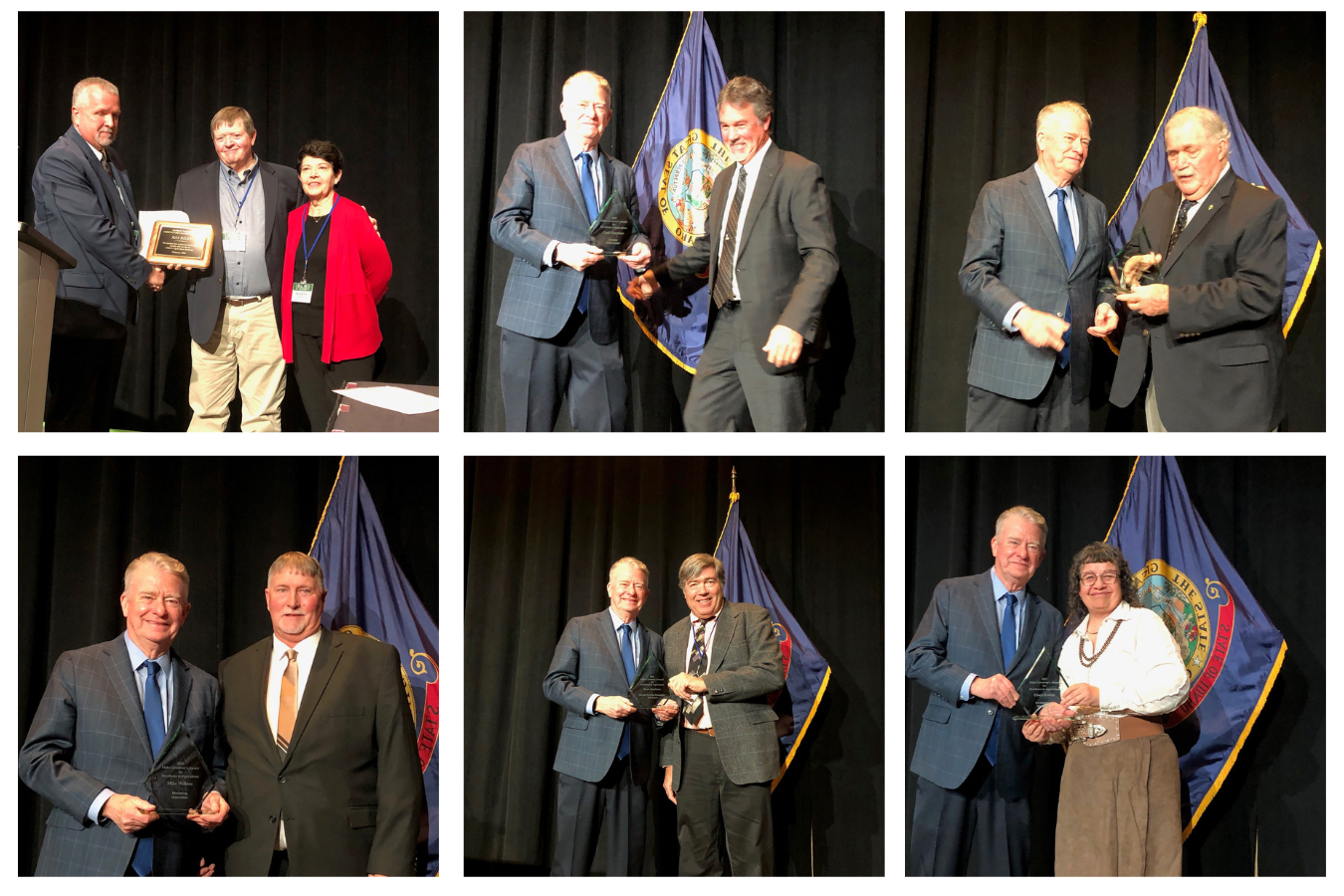
During Ag Summit, Governor’s Awards for Excellence in Agriculture are awarded.
As usual, five people received the awards this year.
“It’s always great to be here,” said Gov. Brad Little, a rancher and farmer. “These awards are incredibly important to the state of Idaho.”
As Idaho continues to grow rapidly and more newcomers arrive who know little about the state’s important agricultural industry, it’s important that they hear about the engine that runs the state’s economy and way of life, Little said.
“Those of us in agriculture know these people; we know what they’ve done for our industry,” he said about the award recipients. “But these awards highlight to the rest of Idaho all the good things we do in agriculture … This is incredibly important to the state of Idaho.”
Ririe grain farmer Clark Hamilton received a Lifetime Achievement Award. He and his wife, Kristi, own and manage a diverse 6,000-acre farm in Bonneville County.
Hamilton spent several years serving and representing Idaho wheat and barley growers as an executive officer of the Idaho Grain Producers Association. He also took leadership roles with U.S. Wheat Associates, which develops, maintains and expands international markets.
According to his award bio, “Clark is passionate about sharing U.S. and Idaho wheat with the world.”
“Clark often participates in worldwide wheat marketing conferences and has hosted many international trade teams of buyers, millers, and bakers on his farm in Ririe to promote U.S. and Idaho Wheat,” the bio adds. “His insights and collaborative approach have helped identify new opportunities for marketing U.S. wheat and foster stronger connections with overseas customers.”
Rupert barley farmer Mike Wilkins received a Marketing Innovation Award.
According to his award bio, his love of agriculture began early while growing up on his family’s crop and dairy farm.
“Mike is an outstanding advocate for the Idaho barley industry and Idaho agriculture,” his bio states. “Mike has been a champion for barley research in Idaho and nationally.”
He has been involved with the National Barley Improvement Committee for more than five years, advocating for federal funds for barley research. He also serves on the Idaho Barley Commission.
“He continually strives to ensure that the best work is being done toward helping Idaho growers,” his award bio states. “Mike has also been a positive spokesperson for the commission and Idaho barley industry, giving many interviews to agricultural media during his service.”
The Technical Innovation Award was presented to Bill Meadows of Mountain States Oilseeds.
“Mountain State Oilseeds helps Idaho’s oilseed growers stay abreast of new technology,” his award bio states.
When Meadows began dryland farming in 1973, his operation grew mustard, safflower and flax; he added camelina in 2007.
“Bill has learned that specialty crops can break the disease cycle in dryland farming operations,” his bio states.
According to the bio, Meadows Dryland Farming was the first farm in Power County to use strip cropping, moving from traditional wheat fallow rotation to a flexible rotation using less summer fallow.
“The addition of oilseeds in the rotation not only is used to break up disease and pest cycles in wheat, but it allows more land to be cropped each year,” his award bio states.
Eileen Rowan was presented the Environmental Stewardship Award. She has been a water quality resource conservationist for the Idaho Soil and Water Conservation Commission since 1997.
“Eileen Rowan’s exceptional contributions to environmental conservation and sustainability describe her unwavering dedication to assuring the sustainability of agricultural practices in northcentral Idaho,” her award bio states.
“Eileen has played a pivotal role in implementing Total Daily Maximum Load projects across Lewis, Idaho and Clearwater Counties,” her award bio states.
She has written and assisted with obtaining more than 76 grants for district projects.
“Her meticulous mapping, profile descriptions and data analysis have provided invaluable insights into soil composition and characteristics,” her bio states.
Steve Stuebner was presented with the Michael Parrella Education and Advocacy Award.
“Steve Stuebner is an untiring advocate for practices, projects, and programs that enhance the economic productivity and environmental quality of our state,” his award bio states.
Stuebner is an avid outdoor recreationist, experienced journalist and self-described environmentalist. Over many years, his bio states, he has helped the agricultural community by continuing to produce high-quality documentation of the industries that fuel Idaho, Including the livestock industry and its role in Idaho’s rangelands.
He has produced nearly 100 in-depth videos covering issues facing ranchers from Bonners Ferry to Preston and everywhere in between. His work has encompassed topics such as wolves, stream restoration, rules of the range for recreation, and more.
“His efforts and connection to healthy, productive grazing operations, as well as his understanding of the needs of many of Idaho’s citizens who utilize these rangelands for recreation, has played a vital role in continued efforts to keep Idaho the state we all enjoy,” his bio states.
During the summit, Kay Riley was presented with the Pat Takasugi Leadership Award, which is named after the late director of the Idaho State Department of Agriculture and given to someone who has shown strong leadership for Idaho agriculture.
“… it is truly an honor to stand before this group of Idaho agricultural leaders to present an award that carries my late husband Pat’s name and the values he believed so strongly in,” Suzanne Takasugi said while presenting the award to Riley, who was a business partner with the Takasugis.
Suzanne Takasugi said Riley “is someone whose career, character, and commitment reflect everything the Pat Takasugi Leadership Award represents.”
Riley grew up on a family fruit farm in Utah and “what started as a ‘couple of weeks’ helping us at a packing facility turned into nearly five decades of leadership in the fruit and onion industry across Utah, Oregon and Idaho,” Suzanne Takasugi said.
Riley went from managing fruit and onion packing operations to serving as vice president of operations at Muir-Roberts Co., to co-founding Snake River Produce in Nyssa, Ore.
“Kay has consistently stepped forward when leadership was needed,” Suzanne Takasugi said. “He helped build businesses, guide ownership transitions, and strengthen the Treasure Valley onion industry for generations to come.”
Still can't find what you are looking for? Find by topic:
- County Presidents & Board Information
- County Resource Page
- Delegate Form
- Discount Programs
- Discussion Meet
- Discussion Meet - High School
- Education Programs
- Events
- Excellence Award (YF&R)
- Expense Voucher
- Flickr- Photos
- Gem State Producer
- High School Discussion Meet
- High School Speech Contest
- Hope in Idaho Ag
- House of Delegates Credentials Form
- IFBF Board of Directors
- IFBF Staff
- Insurance
- Issue Advisory
- Legislative Action Program
- Legislative Issues
- Library
- MAC Trailer
- Magazines
- Map My Benefits
- Member Benefits
- Member Discount
- Membership Application
- Mental Health Resources
- Mission Statement
- Moving Agriculture to the Classroom
- Newsletter Sign up
- News Releases
- News Room
- Open Range Law
- Photo Contest
Thank You to Our Partners


