
Farm groups celebrate Idaho ag at the Capitol
By Sean Ellis
Idaho Farm Bureau Federation
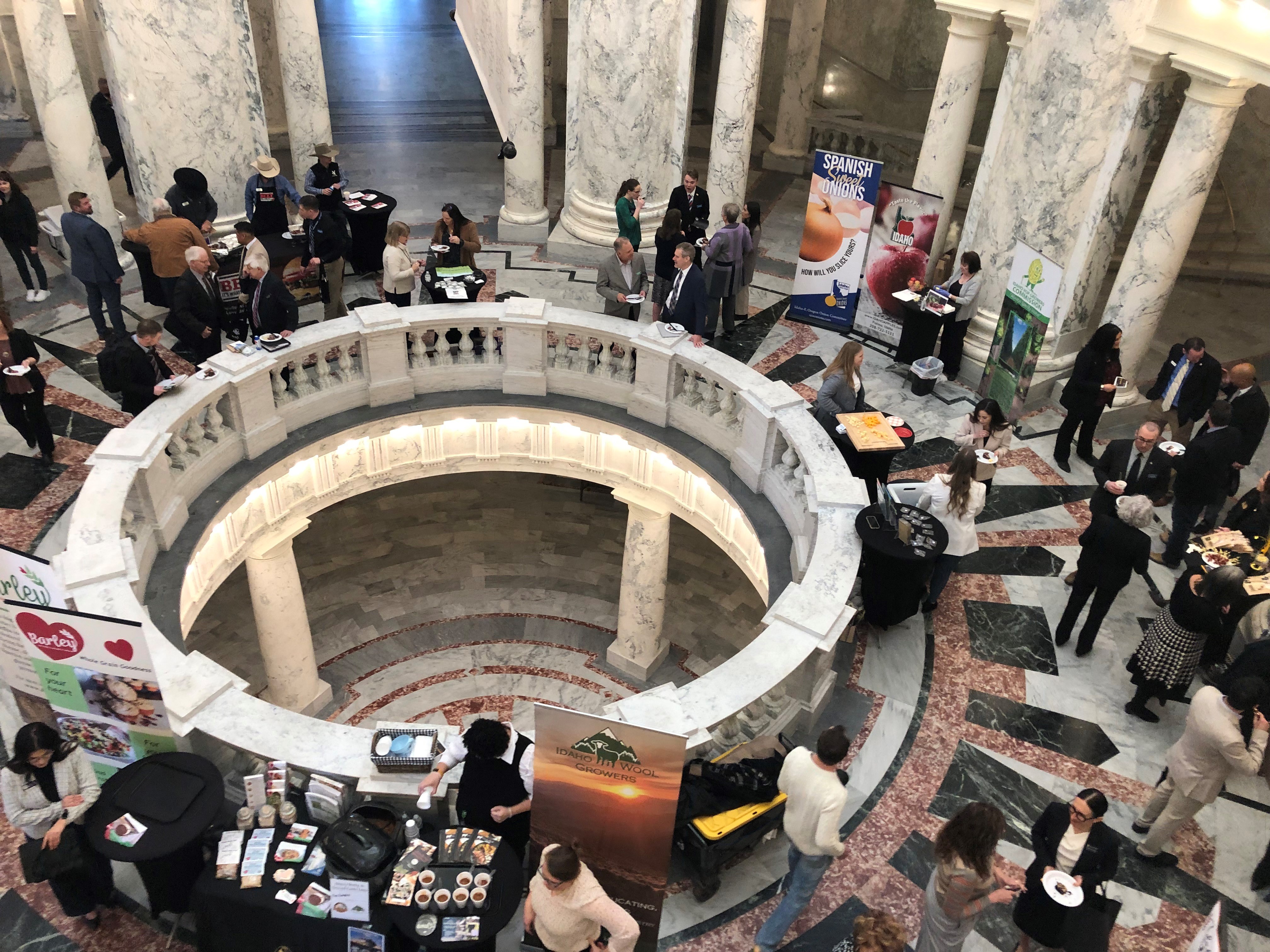
BOISE – About 14 farm groups joined together inside the state’s Capitol building Jan. 13 to celebrate Idaho agriculture and help educate legislators and the general public about Idaho’s agricultural industry.
The annual Idaho Agriculture Day event, organized by the Idaho State Department of Agriculture, is a chance for farm and ranch groups to showcase the state’s important agricultural sector.
Idaho has more than 22,000 farms and ranches that produce more than 180 agricultural commodities.
A University of Idaho report found that agriculture accounts for one in every nine jobs in Idaho, 17 percent of total sales and 13 percent of the state’s gross domestic product.
The ag day display, set up on the second floor of the Capitol Rotunda, was open to the public. Many legislators and their aides visited the display, as well as the governor and lieutenant governor, who are both ranchers and farmers.
The theme of this year’s event was “A Taste of Idaho Agriculture” and the farm groups that participated each brought a test-sized sample that represented their commodity.
Visitors were able to sample potatoes, beef, cheese, lamb, barley and even a chocolate bean cake that used pinto beans instead of flour as an ingredient but tasted nothing like beans.
There were so many free samples available that a person could eat lunch at the event and some people did.
Idaho is the No. 1 producer of bean seed in the United States and normally ranks about No. 5 in total bean production. Idaho Bean Commission Executive Director Andi Woolf-Weibye said the event was a way to educate legislators about Idaho’s significant bean industry as well as let people know that beans can be used in a wide variety of ways.
“You can use beans in a lot of different ways – as opposed to just your traditional chili and baked beans – in order to increase your protein in other recipes,” she said.
Legislators and others visiting the Capitol building were greeted with a whole host of facts about Idaho agriculture, including that Idaho exports bean seed to more than 45 countries, or that Idaho is the nation’s No. 1 barley state and produced 39 percent of country’s total supply of barley last year.
“I think the purpose of today is to really highlight and showcase agriculture in Idaho for our legislators and legislative aides,” said Liz Wilder, executive director of the Idaho Wool Growers Association. “This is a great event that really allows us to showcase the ag products that we offer in Idaho, as well as interact and interface with these policy makers and really drive home the important role that agriculture plays in Idaho’s economy.”
The event was also an opportunity to show the public just how big and diverse the state’s agricultural industry is, she added.
“Everyone thinks meat and potatoes, and dairy, when they come to Idaho, but there is so much more depth to our agricultural industry here in Idaho,” Wilder said. “From barley to hops to lamb to fruit, we offer a really large range of (commodities) in Idaho and we want to showcase that.”
Idahoans have traditionally been pretty good about recognizing what the agriculture industry brings to the state, said Sydney Anderson, communications manager for the Idaho Barley Commission.
“But Idaho is growing,” she added. “So it’s our job within agriculture to tell our story and make sure legislators and other people know how important the agricultural industry, and barley, are to the state.”
It's pretty much agreed in agriculture that most people outside the industry don’t understand what it takes to put food on their table and keep it on grocery store shelves, said Rep. Shawn Dygert, R-Melba, a recently retired high school agriculture education teacher and FFA advisor.
Even a lot of legislators don’t truly understand just how big and important the state’s agricultural sector is, he added, and the ag day celebration is a chance to educate lawmakers and others about Idaho agriculture.
“Any time we can give people an appreciation of what it takes to put food on their tables is always a win,” he said.
Britany Hurst Marchant, executive director of the Idaho Wheat Commission, said her message to legislators differed somewhat from the message she wanted to give to members of the general public that attended the event.
“To legislators, I want to impress on them the importance of the commission: what the commission does, that it’s grower-governed, grower-led and grower-funded,” she said.
For the public, she added, it was a chance to inform them that wheat is a major crop in Idaho – the state is one of the nation’s main wheat-growing states – and that it is an important part of the diet: “It provides a lot of vitamins and minerals and nutrients that we need.”
Still can't find what you are looking for? Find by topic:
- County Presidents & Board Information
- County Resource Page
- Delegate Form
- Discount Programs
- Discussion Meet
- Discussion Meet - High School
- Education Programs
- Events
- Excellence Award (YF&R)
- Expense Voucher
- Flickr- Photos
- Gem State Producer
- High School Discussion Meet
- High School Speech Contest
- Hope in Idaho Ag
- House of Delegates Credentials Form
- IFBF Board of Directors
- IFBF Staff
- Insurance
- Issue Advisory
- Legislative Action Program
- Legislative Issues
- Library
- MAC Trailer
- Magazines
- Map My Benefits
- Member Benefits
- Member Discount
- Membership Application
- Mental Health Resources
- Mission Statement
- Moving Agriculture to the Classroom
- Newsletter Sign up
- News Releases
- News Room
- Open Range Law
- Photo Contest
Thank You to Our Partners


