
Crapo highlights ag wins in Big Beautiful Bill
By Sean Ellis
Idaho Farm Bureau Federation
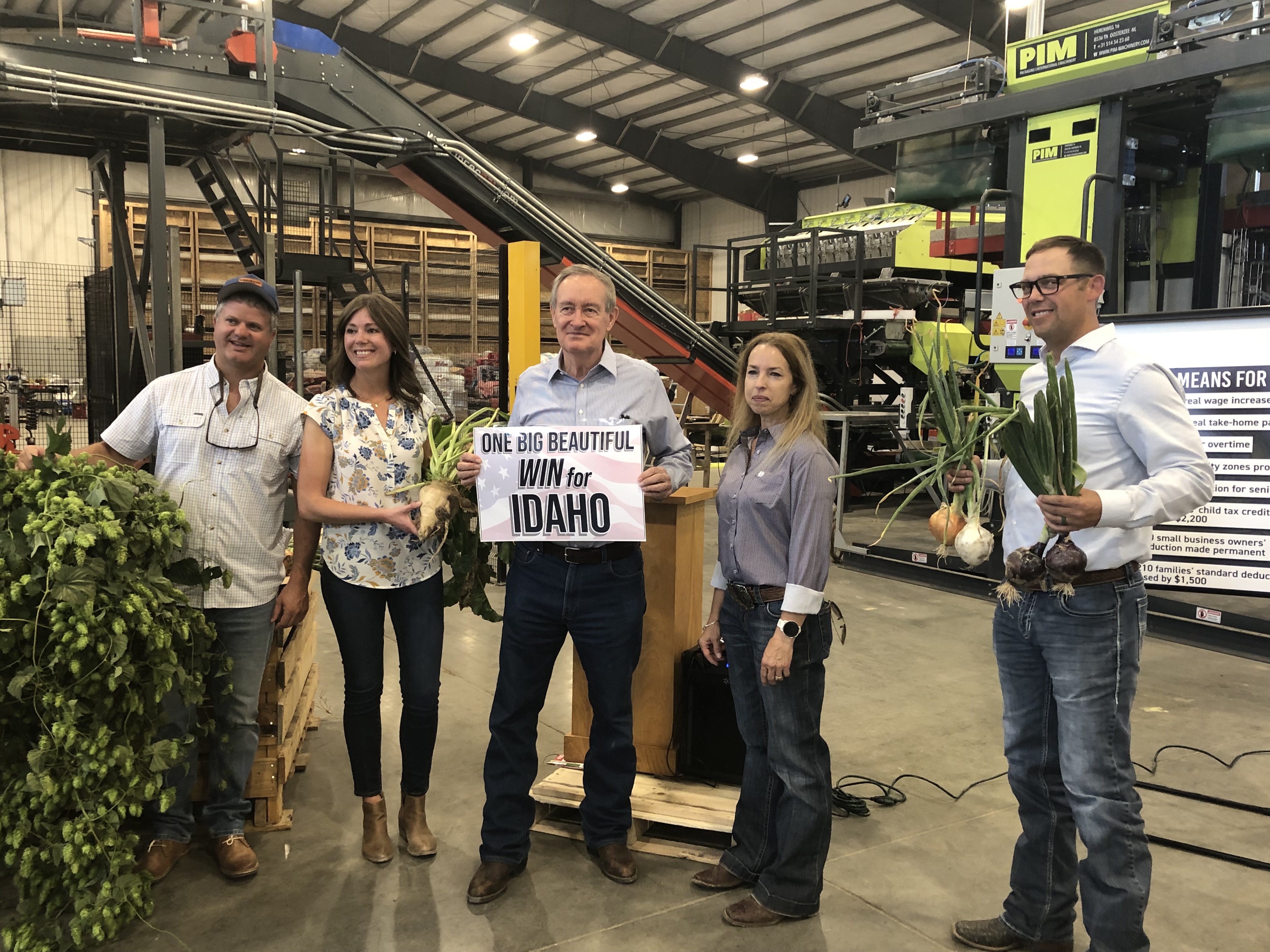
PARMA – The One Big Beautiful Bill Act represents a major win for farmers and ranchers, Sen. Mike Crapo, R-Idaho, told Idaho agriculture industry representatives Aug. 20.
“This bill did more for the agriculture industry than maybe any other industry,” Crapo said during a tour of Obendorf Farms, where he highlighted key provisions for farmers and ranchers included in the bill (OBBB). “The parts in the bill that benefited agriculture were so numerous that I have to have a set of papers here to read from … in order to make sure I cover it all.”
People representing some of Idaho’s main agricultural commodities were on hand to explain how the provisions of the act will benefit farmers and ranchers.
The bill, signed into law on July 4, “preserves Farm Bureau-supported provisions, strengthens the farm safety net and offers longer-term certainty for farmers and ranchers navigating rising input costs, volatile markets and weather uncertainty,” American Farm Bureau Federation economists wrote in a Market Intel report about the OBBB.
They said the act is projected to increase agriculture-focused spending by about $66 billion over the next decade.
“The One Big Beautiful Bill Act delivers long-overdue policy certainty by strengthening core safety net programs, enhancing risk management tools and locking in important tax provisions for family farms,” the AFBF economists wrote. “It reflects many of Farm Bureau’s top priorities and offers measurable wins for producers navigating an increasingly complex farm economy.”
One provision of the act that should put a smile on every farmer in the room’s face, Crapo said, is the one that provides estate tax relief for family farms by making the “death tax” exemption permanent at $15 million per individual or $30 million per couple and indexes it for inflation.
Without this change, the death tax exemption was due to drop back to $5.5 million after 2025.
Crapo’s comments about the death tax provision brought applause.
Raising the death tax exemption “is a huge win for us,” said Kim Brackett, who spoke on behalf of the cattle industry at the Crapo event. “We will continue to advocate for complete repeal of the death tax, but this is a huge increase and a major step forward providing greater certainty for Idaho’s cattle producers in family transition planning.”
Crapo noted that the bill extends the U.S. sugar program through 2031 and includes other provisions sought by the sugar industry.
Idaho ranks No. 2 in sugar beet production in the country and sugar is a billion-dollar industry in Idaho, said Samantha Parrott, executive director of the Snake River Sugarbeet Growers Association.
“Without a new farm bill, this legislation became our best path to address the needs of the sugar industry,” she said.
Some of the provisions in the bill might sound like technical changes to most people, “but for growers it means stability,” Parrott said. “And that stability helps them grow their operation, invest in equipment, hire workers, and it keeps farms in the family for the next generation.”
She said provisions in the bill “represent the most meaningful update to the U.S. sugar policy in the history of the program. While we still have more work to do with the upcoming farm bill, the OBBB act is a major victory….”
The bill extends dairy margin coverage through 2031. Milk is Idaho’s No. 1 ag commodity in terms of total farm-gate revenue.
The bill increases premium support for beginning farmers and ranchers by expanding USDA’s definition from five to 10 years of experience. This will enable more producers to qualify for assistance over a longer period of time.
It supports investments in agriculture research and conservation programs and agriculture trade opportunities. It strengthens crop insurance, including extending coverage for beginning farmers and ranchers.
“Crop insurance remains a cornerstone of the farm safety net, and the bill makes several significant updates to strengthen and modernize the program through 2031,” the AFBF economists wrote in their Market Intel report.
The bill’s strengthened crop insurance and disaster aid programs “will help us weather unpredictable events, whether it’s severe weather, a drought or even helping in a market downturn in the industry,” said Brock Obendorf, owner of Obendorf Farms, which produces hops, onions, sugar beets, corn, cattle and wheat.
He said there are several pieces of the bill “that will benefit the future of agriculture. The bill strengthens our ability to keep growing high-quality crops, sustain rural economies and compete in global markets.”
Corey Coles, who manages the sale of onions at Obendorf Farms and is a member of the Idaho-East Oregon Fruit and Vegetable Association, spoke about how provisions of the OBBB will benefit the onion industry and all of agriculture.
While farmers would rather depend on a free market and limited government support, “food production should always be a priority on a federal level and safety nets are vital to guarantee there’s a tomorrow for agriculture businesses,” he said ... “This helps to ensure the family farm can still play a vital role in the production ag world when prices fall to below break-even levels for extended periods of time.”
Brackett, a cattle producer in Owyhee County and vice president of the National Cattlemen’s Beef Association, highlighted several provisions of the OBBB that she said would help her operation and the entire industry.
“There are some real key components of the farm bill that were addressed in the (bill) for cattle producers,” she said.
These provisions will allow “us as cattle producers to keep more of what we’re actually earning … (and) reinvest back in our operations,” Brackett said.
While the bill contains numerous provisions that farmers and ranchers wanted to see addressed in a new farm bill, it doesn’t preclude the need for an updated farm bill, Crapo said. However, he added, it should make it “easier to get that bill over the line.”
In their Market Intel report, the AFBF economists wrote that the OBBB is not a complete substitute for a new farm bill.
“Crafted through the reconciliation process, the (OBBB) was shaped by budget and jurisdictional limits that excluded several important areas of farm and rural policy,” they wrote.
Still can't find what you are looking for? Find by topic:
- County Presidents & Board Information
- County Resource Page
- Delegate Form
- Discount Programs
- Discussion Meet
- Discussion Meet - High School
- Education Programs
- Events
- Excellence Award (YF&R)
- Expense Voucher
- Flickr- Photos
- Gem State Producer
- High School Discussion Meet
- High School Speech Contest
- Hope in Idaho Ag
- House of Delegates Credentials Form
- IFBF Board of Directors
- IFBF Staff
- Insurance
- Issue Advisory
- Legislative Action Program
- Legislative Issues
- Library
- MAC Trailer
- Magazines
- Map My Benefits
- Member Benefits
- Member Discount
- Membership Application
- Mental Health Resources
- Mission Statement
- Moving Agriculture to the Classroom
- Newsletter Sign up
- News Releases
- News Room
- Open Range Law
- Photo Contest
Thank You to Our Partners


