
Backbone of the economy: food and ag sectors
By Sean Ellis
Idaho Farm Bureau Federation
 POCATELLO – The combined food and agriculture sectors have a combined massive impact on the U.S. economy, according to a recently released report.
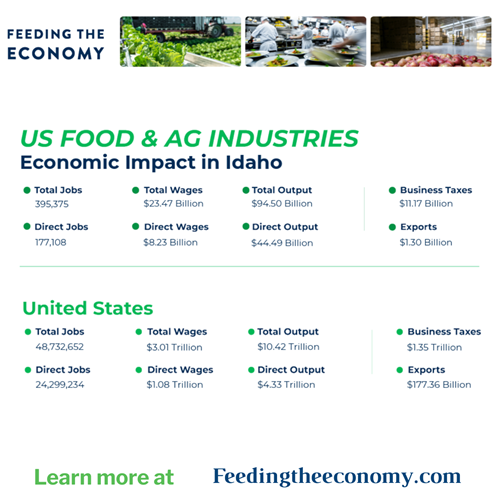
According to the 2026 Feeding the Economy report, the two sectors together generate more than $10.4 trillion in economic value to the U.S. economy. That represents almost 20 percent of the nation’s overall economy.
The annual report, which was released March 23, shows that America’s food and ag sectors support 48.7 million jobs across the country, including more than 24 million direct jobs in farming, manufacturing, processing, distribution, retail and foodservice.
It also found that the two industries generate more than $3 trillion in wages for American workers, $177 billion in exports and $1.35 trillion in tax revenue for federal, state and local governments.
According to the report, food manufacturing in the United States employes more than 2.28 million workers.
The report did identify several challenges faced by the sectors.
It reported: “Direct employment in production agriculture and food manufacturing remained largely flat year-over-year, reflecting pressures on farmers, producers and rural communities.”
It also found that export values declined, in inflation-adjusted terms, over the past decade, “further demonstrating the importance of stable and reliable international markets for U.S. agriculture.”
The annual report is sponsored by 35 food and agriculture groups, including American Farm Bureau Federation.
In one of his weekly columns, AFBF President Zippy Duvall called the report a “powerful reminder that what starts in our fields reaches into every part of American life.”
“The work farmers do sets off a chain reaction that touches every community,” he added. “Food moves from farms to processing plants, onto trucks and into stores and restaurants. Along the way, it creates jobs, generates income and supports the service we all rely on.”
It all starts on the farm, but it doesn’t end there, Duvall wrote.
“Whether you farm 5 acres or 5,000, you’re part of something bigger than your own farm,” he said. “You’re helping support jobs, strengthen communities and power an economy that reaches every corner of this country.”
The report breaks down the impact of the food and agriculture industries by state. It shows the two sectors account for 395,375 total jobs and $23.5 billion in wages in Idaho.
In addition, it shows the sectors account for $94.5 billion in total economic output in Idaho and $11.2 billion in business taxes.
“Wow, those are some really big numbers and confirm what many people involved in agriculture already know: that the combined food and agriculture sector is one of the major players in the Idaho and U.S. economy,” said Idaho Farm Bureau Federation President Matt Dorsey.
Dorsey, who farms in Canyon County, encouraged farmers and other involved in the industry to share these numbers, particularly with lawmakers and other elected officials.
According to the report, the economic impact of the two sectors begins on the country’s nearly 2 million farms and ranches.
From there, it expands rapidly, “powering innovation, manufacturing, transportation, retail and foodservice across every state.”
It adds that almost 200,000 food manufacturing, processing and storage facilities employ millions of food scientists, production workers, logistics experts, truck drivers, engineers and others “who keep supply chains resilient and responsive.”
“The impact continues at more than 1 million restaurant and foodservice establishments and roughly 200,000 retail food stores, where food and agriculture products drive consumer spending in communities nationwide,” the report states.
The ripple effects extend even further.
“Wages earned across the food and agriculture supply chain are reinvested locally, supporting housing, health care, education, small businesses and infrastructure,” the report adds. “In many rural communities, food and agriculture’s economic activity is the backbone of the local economy.”
The 2023 report breaks down the food and ag sectors’ economic impact by county.
For example, it shows that in Canyon County (population 238,000) the two sectors support 34,518 jobs, $1.9 billion in total wages and $8.3 billion in total economic output.
Even in comparatively small Fremont County – population 14,000 and change – the industries support 2,294 jobs, $132 million in wages and $352 million in economic output.
To view that county-level data online, go to: https://feedingtheeconomy.com/county-level-data/
The following are quotes from leaders of organizations involved in sponsoring the report that are included at FeedingTheEconomy.com.
“This report is a leading resource to help Congress, the administration and agricultural stakeholders understand the simple truth that the food and agriculture sectors are powerful economic engines that drive growth and opportunity across both rural and urban America.” – John Newton, American Farm Bureau Federation.
“Each year, the Feeding the Economy report shows how American food and agriculture power the engine of U.S. prosperity. From producers and processors to retailers, chefs, manufacturers, transportation professionals and the scientific community, agriculture and the people who build on it form a pillar of the U.S. economy.” – John Bode, president and CEO, Corn Refiners Association.
“Agriculture is a cornerstone of the U.S. economy.” – Christy Seyfert, president and CEO, Farm Credit Council.
“Agriculture is the backbone of the U.S. economy and these numbers illustrate just how critical the women and men of the food and farm sector are to the overall picture.” – Sam Kieffer, CEO, National Association of Wheat Growers.
Still can't find what you are looking for? Find by topic:
- County Presidents & Board Information
- County Resource Page
- Delegate Form
- Discount Programs
- Discussion Meet
- Discussion Meet - High School
- Education Programs
- Events
- Excellence Award (YF&R)
- Expense Voucher
- Flickr- Photos
- Gem State Producer
- High School Discussion Meet
- High School Speech Contest
- Hope in Idaho Ag
- House of Delegates Credentials Form
- IFBF Board of Directors
- IFBF Staff
- Insurance
- Issue Advisory
- Legislative Action Program
- Legislative Issues
- Library
- MAC Trailer
- Magazines
- Map My Benefits
- Member Benefits
- Member Discount
- Membership Application
- Mental Health Resources
- Mission Statement
- Moving Agriculture to the Classroom
- Newsletter Sign up
- News Releases
- News Room
- Open Range Law
- Photo Contest
Thank You to Our Partners


